

By imaging for the first time at high resolution and in 3D the magmatic system under the East Pacific Ridge, an international team led by Milena Marjanović, CNRS researcher at the Institut de Physique du Globe de Paris, sheds light on the morphology of the magma lenses representing the last stages of magma before eruptions of lava on the surface.
The study, published on September 29 in the journal Science Advances, shows that the shape of these small magma reservoirs remembers the processes of magma recharge and drain, influencing the dynamics of future eruptions.
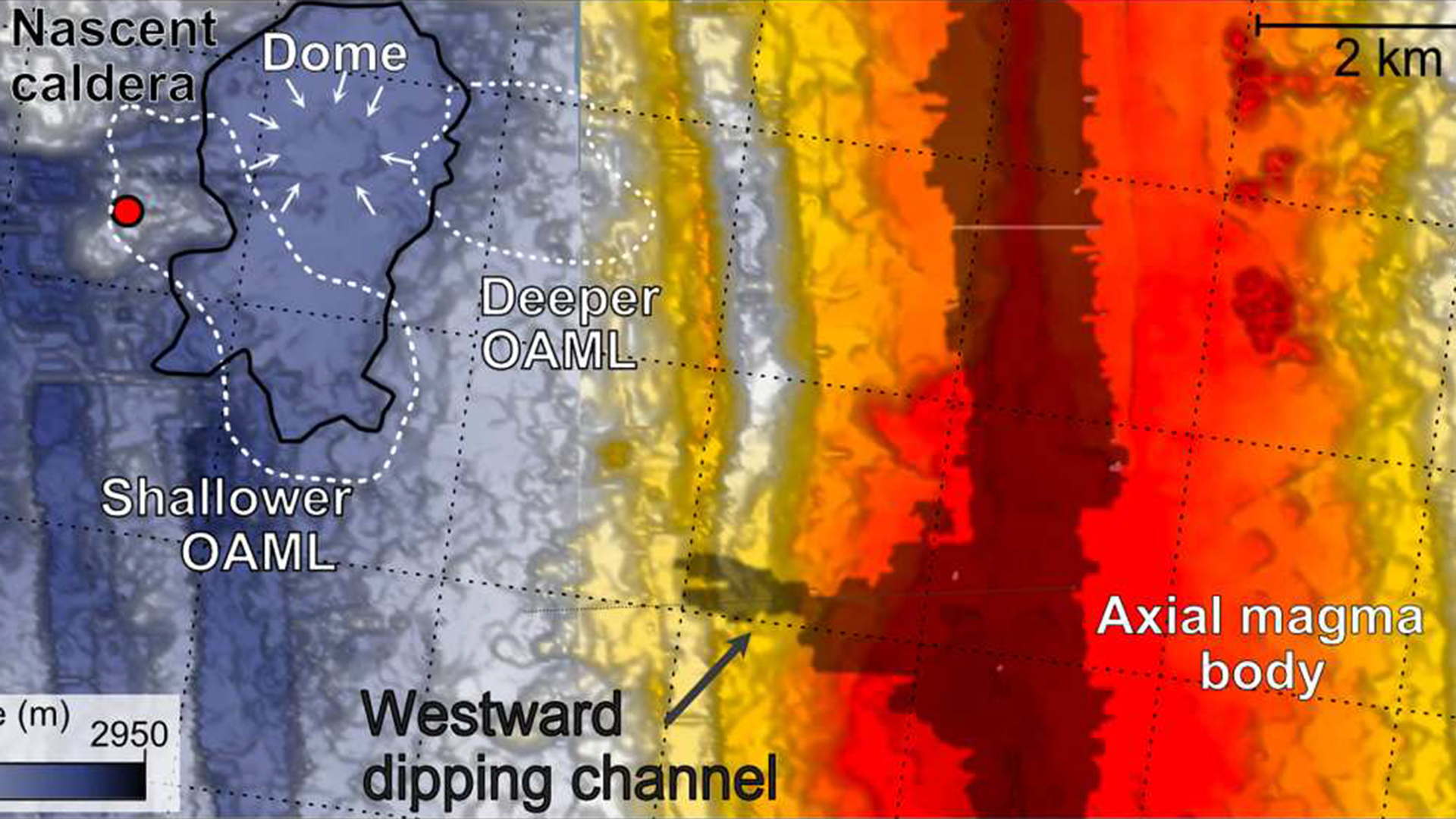
© Marjanovic – CNRS-IPGP
Numerical modeling results show that the architecture of magma plumbing systems between the Earth’s mantle and surface and how magma evolves through these systems play a fundamental role in the construction and evolution of volcanic edifices. However, due to the inaccessibility of most active volcanic systems to high-resolution imaging, the detailed morphology of the most superficial magma reservoirs and the relationship between magma upwelling initiation and eruption dynamics still need to be discovered.
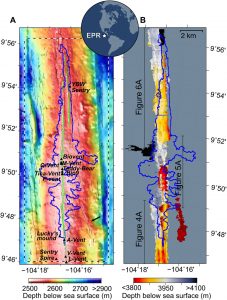
Topography and tectonics of the ocean floor (left) and 3D morphology of magmatic lenses beneath the surface (right) of a segment at the East Pacific Rise. © Marjanovic – CNRS – IPGP
A study published on September 29 in Science Advances by an international team involving scientists from the CNRS, the Institut de Physique du Globe de Paris and Université Paris Cité presents unprecedented high-resolution seismic images that shed light on the small-scale architecture of the network of shallowest magma bodies, located beneath an erupting zone of the East Pacific Rise. These images, the result of a close collaboration with industry experts, which enabled a cutting-edge imaging technique, were obtained by inverting the waveforms of seismic reflection data acquired during a marine research cruise conducted in 2008.
The study reveals that these lenses, which were until now modeled as smooth bodies, in reality present ridges and troughs which are interpreted as zones where repeat dikes (seams of magma which rise from the reservoir up to the surface) nucleate. This peculiar morphology is sculpted by the processes of magma recharge from the mantle and magma extraction towards the surface. The recurrence of these processes leaves an imprint, linked to the concentration of stresses induced by the topography, which contributes to the nucleation of the dikes and the triggering of the rise of magma towards the surface and more broadly to the dynamics of subsequent eruptions.
By including these new results in the latest generation of three-dimensional numerical models, it should now be possible to obtain a more realistic representation of volcanic systems which will contribute to better localization of eruptions, and thus to the improvement of risk assessment.
References:
> Insights into dike nucleation and eruption dynamics from high-resolution seismic imaging of magmatic system at the East Pacific Rise, Marjanović et al., Sci. Adv. 9, 2023.
À lire aussi

L’Université Paris Cité au City Tour Maroc 2026
Du 28 septembre au 2 octobre 2026, l’Université Paris Cité participe au City Tour Maroc, une opération organisée par le groupe L’Étudiant. À cette occasion, l'équipe de pôle de l'orientation et de la professionnalisation de l'université part à la rencontre des...
read more
Call for Interdisciplinary Research Proposals: Sciences Po & Université Paris Cité 2026
As part of the partnership between Université Paris Cité and Sciences Po, a new call for proposals has been launched to identify large-scale, interdisciplinary and collaborative research projects addressing major contemporary issues. This call will take place in two...
read more
Do you have to be bilingual to participate in Circle U. activities
Going abroad to study in a foreign language can seem intimidating. Yet a first experience may be all it takes to build confidence and take the leap. Irina tells us how taking part in one of Circle U.’s summer schools helped her gain confidence and prepare for a...
read more
How Circle U. helped me define my career path
Susanna’s journey with Circle U. began with an online course. This first experience allowed her to discover the alliance and marked the beginning of a journey that led her to become a student ambassador, pursue a double degree in Paris, and complete an internship at...
read more