

According to a new study published on August 31st, 2021, in Lancet Public Health, covering 22 countries including most of Europe and representing about 70% of global transplant activity, the number of solid organ transplants performed in the first wave of the pandemic in 2020 fell by 31% compared with the previous year and by more than 15% over the entire year of 2020.
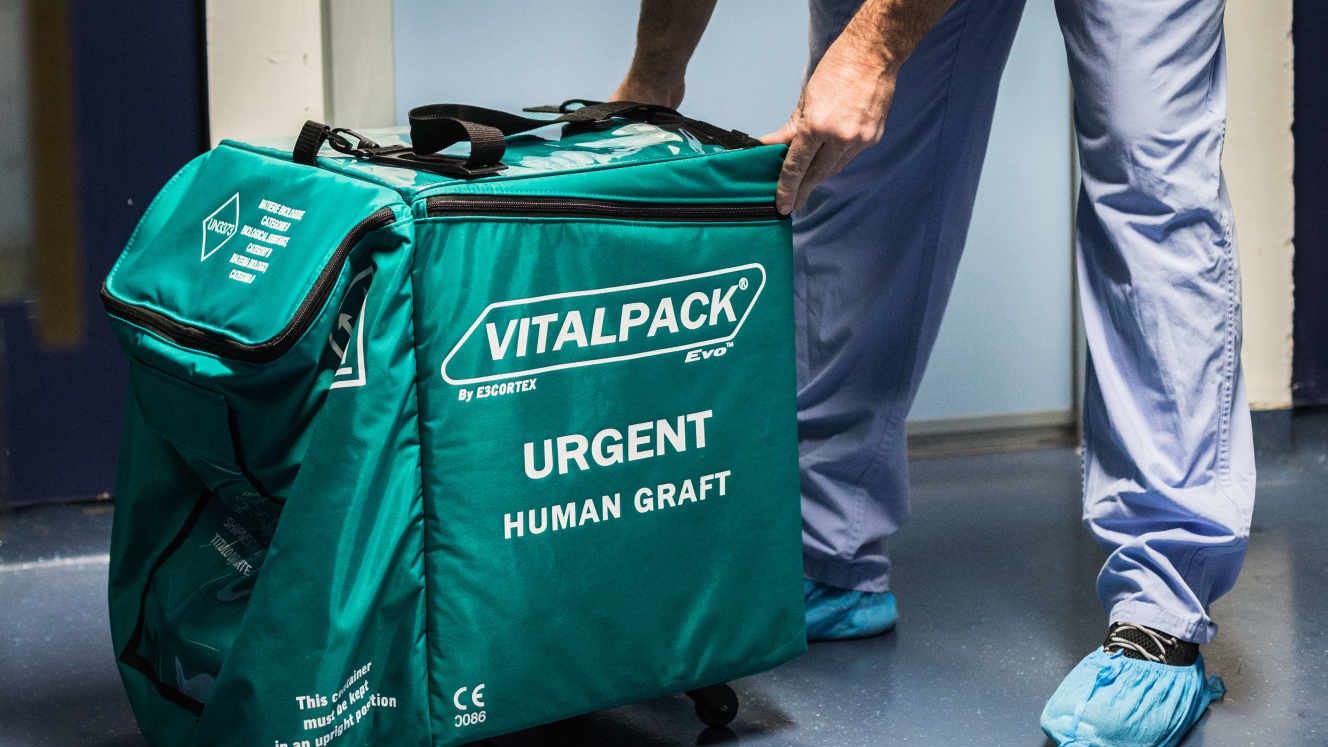
A kidney from a related living donor is stored in an isothermal container prior to transplantation at the Bordeaux University Hospital in November 2020.
©
This unprecedented research, which accurately assesses how Covid-19 has impacted the field of medicine, was conducted by Professor Alexandre Loupy (Université Paris Cité, Hôpital Necker-Enfants Malades AP-HP) and Dr. Olivier Aubert (Université Paris Cité, Hôpital Necker-Enfants Malades AP-HP), both of whom are also researchers at the Inserm Center for Translational Research on Organ Transplantation in Paris (Paris Transplant Group).
At the onset of health crisis, organ transplant programme leaders expressed concern about the ongoing solid organ transplantation activity during the pandemic. There were two major reasons for this: the significant burden on health care systems in managing Covid-19 patients and the increased risk of infection for transplant recipients who are therefore immunocompromised. The recommendations were thus to maintain only urgent transplants, in particular heart and liver transplants, when the organisation of the hospital would allow for it. Until now, there has not been any study undertaken on the global impact of Covid-19 on solid organ transplantation.
In their analysis, the authors used international data from the largest institutions, Agence Biomédecine, NHS, UNOS, EUrotransplant…. which were centralised on secure servers of the Paris Transplant Group. The objective was to investigate the global impact of the pandemic on transplantation, to determine whether the responses from different countries was heterogeneous and to assess the impact of these decisions on the survival ability of these patients waiting for transplants. The study revealed an overall decrease in transplant activity but also large variations in the response of transplant programmes during the pandemic, with transplant activity dropping by more than 90% in some countries. This decline, through statistical modelling calculations, has been shown to correspond to more than 48,000 life-years lost for patients.
At the same time, the study shows that some countries have managed to maintain the pace of transplantation procedures, while others have experienced sharp reductions from the previous year. In some regions, kidney and liver transplants from living donors have stopped altogether. These findings suggest further analysis at the regional, national, and global levels to explain these variations.
For example, kidney transplantation saw the largest reduction in almost all countries in 2020 compared with 2019, and specifically living donor transplants decreased significantly (kidneys: -40%; liver: -33%). With regard to transplants from deceased donors, there is a reduction in kidney (-12%), liver (-9%), lung (-17%) and heart (-5%) transplants.
Overall, the reduction in the number of solid organ transplants in deceased or living persons is temporally related to the increase in the rate of infection by the Covid-19 virus.
Dr. Olivier Aubert, a physician at the Centre for Translational Research in Organ Transplantation in Paris and lead author of the study, said, “The first wave of Covid-19 had a devastating impact on the number of transplants in many countries, affecting patient waiting lists and unfortunately leading to a significant loss of life.”
Professor Alexandre Loupy, Director of the Inserm Center for Translational Research on Organ Transplantation in Paris and final author of the study, adds, “It is clear that many indirect deaths are associated with Covid-19 and our study confirms that the pandemic is having a significant impact on many medical fields.”
The number of life-years lost for all patients was estimated at 37,664 years for patients waiting for a kidney, 7,370 years for a liver, 1,799 years for a lung and 1,406 years for a heart, for a total of 48,239 life-years lost.
To facilitate understanding of the temporal trends and the impact of the pandemic on global, national, and regional solid organ transplantation activities for researchers, clinicians, and public health authorities, the authors created an open-access dashboard that interactively presents data for solid organ transplantation activities and Covid-19 cases.
“Understanding how different countries and health systems have dealt with the challenges of Covid-19 can facilitate improved pandemic preparedness and how to safely maintain transplant programmes to provide life-saving procedures for patients,” concludes Dr. Olivier Aubert.
The Paris Transplant Group brings together a multidisciplinary team dedicated to transplantation, including immunologists, laboratory physicians, researchers, nephrologists, cardiologists, pulmonologists, pathologists, statisticians and public health specialists.
References
COVID-19 pandemic and worldwide organ transplantation: a population-based study – Olivier Aubert, MD † ; Daniel Yoo, MPH † ; Dina Zielinski, PhD † ; Emanuele Cozzi, MD † ; Massimo Cardillo, MD ; Michael Dürr, MD ; Beatriz Domínguez-Gil, MD ; Elisabeth Coll, MD ; Margarida Ivo Da Silva, MD ; Ville Sallinen, MD ; Karl Lemström, MD ; Karsten Midtvedt, MD ; Camilo Ulloa, MD ; Franz Immer, MD ; Annemarie Weissenbacher, MD ; Natalie Vallant, MD ; Nikolina Basic-Jukic, MD ; Kazunari Tanabe, MD ; Georgios Papatheodoridis, PhD ; Georgia Menoudakou, MSc ; Martin Torres, MD ; Carlos Soratti, MD ; Daniela Hansen Krogh ; Carmen Lefaucheur, MD ; Gustavo Ferreira, MD ; Helio Tedesco Silva Jr, MD ; David Hartell, MA ; John Forsythe, MD ; Lisa Mumford, MSc ; Peter P Reese, MD ; François Kerbaul, MD ; Christian Jacquelinet, MD † ; Serge Vogelaar, MD † ; Vassilios Papalois, MD † ; Alexandre Loupy, MD
Contacts
presse@u-paris.fr
Alexandre Loupy : PU-PH Nephrologist at the Necker Enfants malades Hospital AP-HP, Université Paris Cité, and Director of the Inserm translational research team in organ transplantation in Paris
Olivier Aubert : Nephrologist at the Necker Enfants malades hospital AP-HP, Université Paris Cité, and researcher in the Inserm team of translational research in organ transplantation in Paris
Read more

Eiffel Excellence scholarship 2027
The Eiffel scholarship programme launched by France’s Ministry of Europe and Foreign Affairs is now open for the 2027–2028 academic year. The programme enables international students to benefit from a mobility grant and pursue courses at the master’s and doctorate...

Call for Interdisciplinary Research Proposals: Sciences Po & Université Paris Cité 2026
As part of the partnership between Université Paris Cité and Sciences Po, a new call for proposals has been launched to identify large-scale, interdisciplinary and collaborative research projects addressing major contemporary issues. This call will take place in two...
Université Paris Cité stands out once again in the 2026 Shanghai thematic ranking
The Shanghai Global Ranking of Academic Subjects (GRAS) has just unveiled its results for the 2026 edition on Tuesday 15 September. Université Paris Cité has excelled by being ranked in 26 disciplines - including 10 in the global top 50 - and by achieving 1st place in...

Doctoral Mobility: Results of the Call for Projects between Université Paris Cité and the University of Toronto
As part of the strategic partnership between Université Paris Cité (UPCité) and the University of Toronto (U of T), supported by the Initiative d'Excellence (IdEx), the call for doctoral mobility projects launched in 2026 aims to develop joint activities around themes...