

By combining data collected by the SEIS seismometer operated by the InSight mission on Mars with available orbital data, a scientific team has revealed that Martian seismic activity may be responsible for dust avalanches
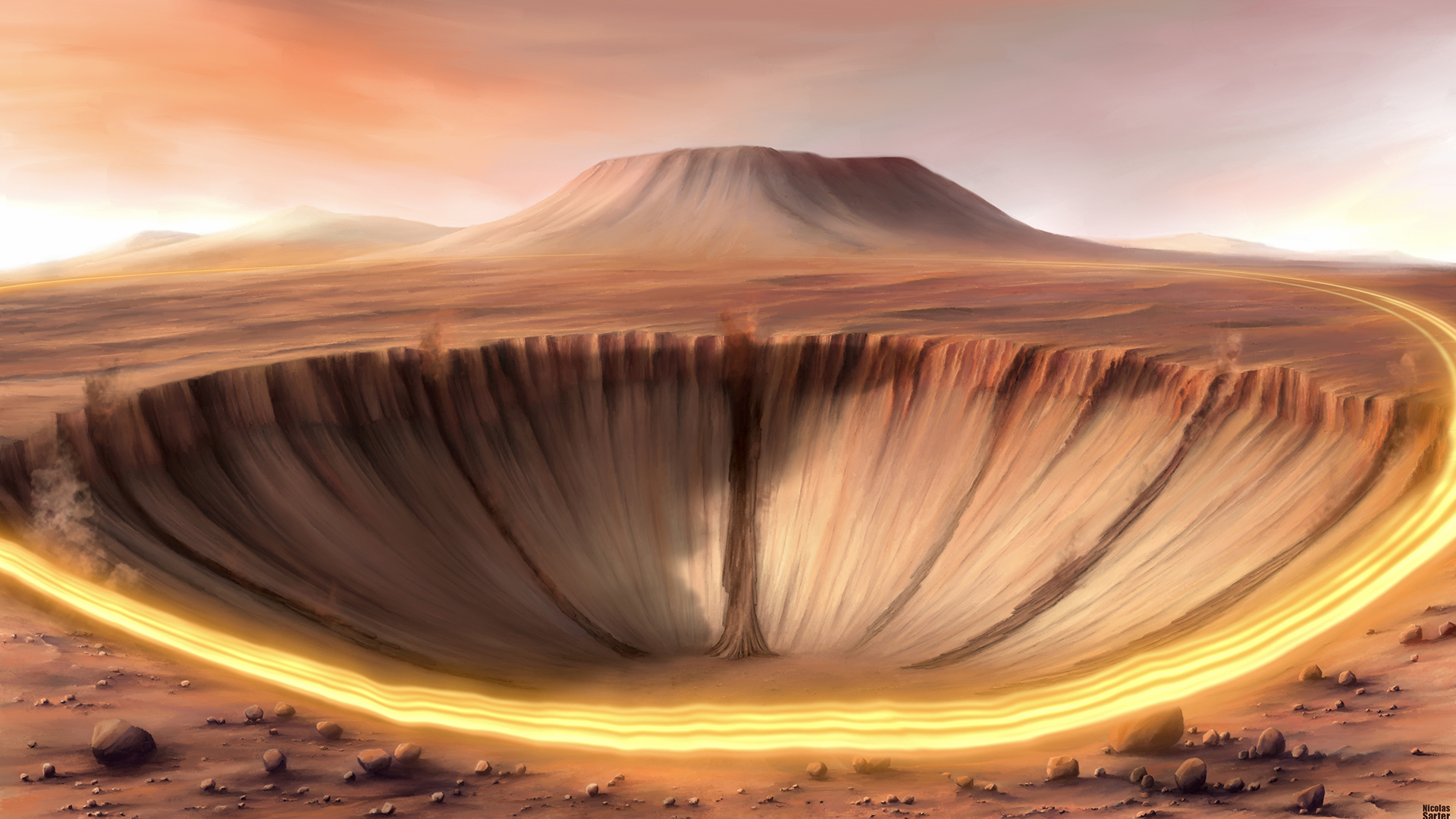
© Nicolas Sarter – IPGP
Thanks to a detailed analysis of both orbital and seismological data from the two largest seismic events recorded during the InSight mission to Mars (operational from the end of 2018 to the end of 2022), a team of researchers from the IPGP (Université Paris Cité / CNRS) and their colleagues have highlighted a clear increase in the number of dust avalanches around the two epicentres.
The first event studied, named S1000a, was a meteorite impact that occurred on 18 September 2021 and generated an earthquake with a local Martian magnitude of 4.1, forming a crater around 150 metres in diameter. A comparison of orbital images before and after this event shows an impressive quantity of new dust avalanches around the epicentre, within a radius of 20 km, generated by strong acceleration at the surface.
The second event, named S1222a, occurred on 4 May 2022 and is the largest earthquake ever detected on Mars, with a magnitude of 4.7. Located near the Apollinaris volcano, close to the Martian crustal dichotomy, its epicentre is probably located at a depth of less than 20 km, although its energy is around 25 times greater than that of the S1000a earthquake. By comparing all the orbital data on the Red Planet available since 2005 with high-resolution orbital images of this second earthquake, the researchers found that the avalanche rate rose from 3% (meaning that for every 100 existing avalanches, 3 new ones appear during one Martian year, i.e. 687 Earth days) to 40% after the earthquake in certain areas.
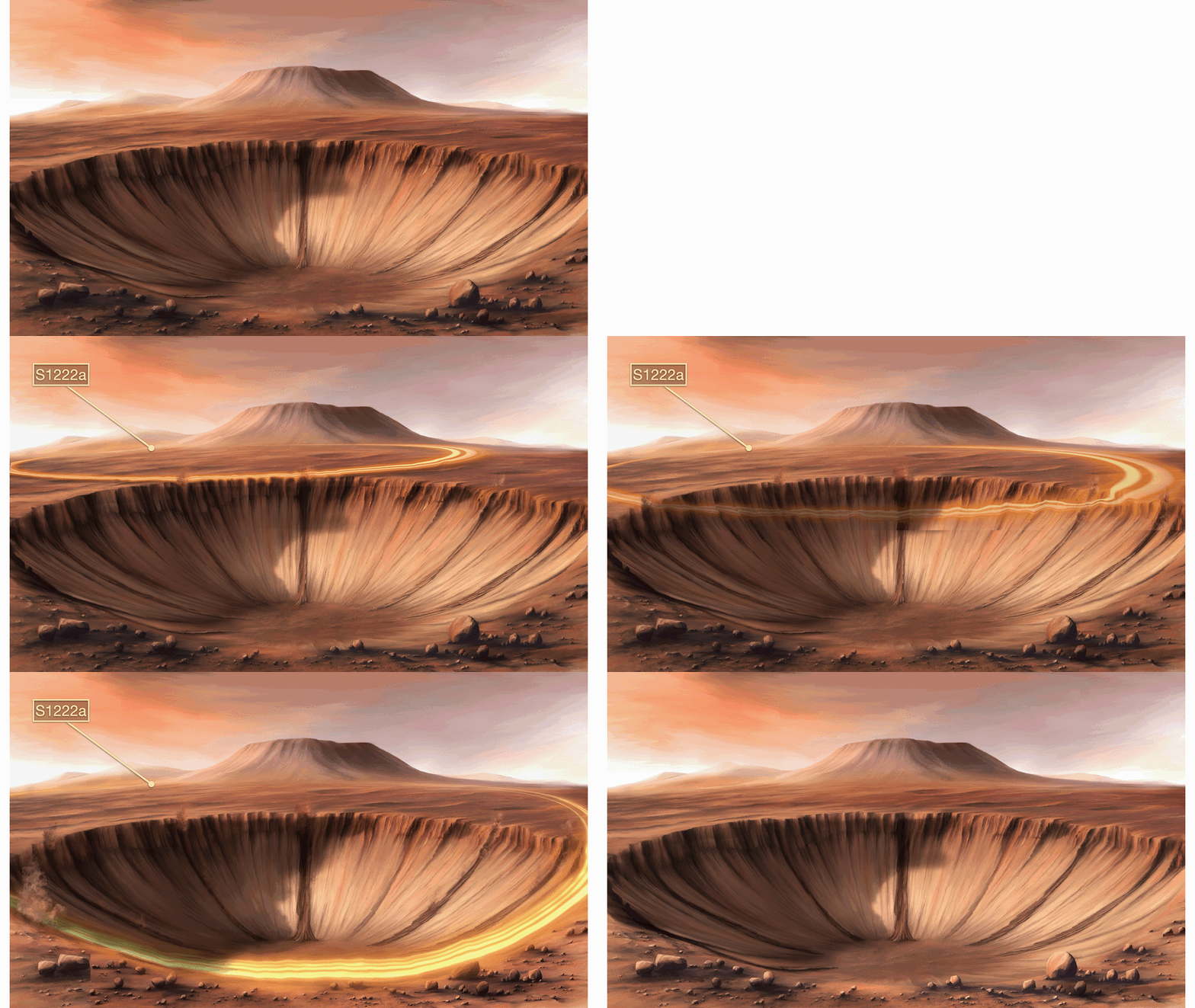
Click on the image to see the animation. © Nicolas Sarter – IPGP
The causal link between this earthquake and the triggering of avalanches is particularly clear given that no storms occurred during the period covered by the images taken before and after the earthquake, and that the slopes on which the avalanches formed do not show any preferential orientation, not even that of the prevailing south-north winds recorded in this region.
On the basis of this result, the scientists then sought to refine the location of the epicentre of the S1222a seismic event, using certain laws used on Earth that interpret the distribution of landslides and avalanches as a function of the epicentres of the earthquakes that triggered them. The position thus obtained allows researchers to make two different interpretations of the mechanism behind the earthquake. The first theory suggests that the seismic activity could be linked to an ancient volcano, Apollinaris Patera, although it is unlikely that it is still active. The second hypothesis suggests that a large geological structure could be the source of the earthquake, a 450 km-long ridge located just next to the epicentral position obtained.
This work paves the way for future research, in particular to better understand how Martian seismic activity can influence surface and subsurface processes. In addition, this study shows that the analysis of surface processes can help us to better understand the mechanisms behind the Red Planet’s current seismicity.
References:
> A. Lucas, I.J. Daubar, M. Le Teuff, C. Perrin, T. Kawamura, L. Posiolova, P. Lognonné, S. Rodriguez, D. Giardini, G. Sainton, A. Mangeney, A. McEwen, Possibly seismically triggered avalanches after the S1222a Marsquake and S1000a impact event, Icarus, Vol. 411, 2024, 115942, DOI : 10.1016/j.icarus.2023.115942.
> Datasets in the IPGP Research Collection: Lucas, Antoine; Daubar, J. Ingrid; Le Teuff, Manon; Perrin, Clément; Kawamura, Taichi; Posiolova, Liliya; Lognonné, Philippe; Rodriguez, Sébastien; Giardini, Domenico; Sainton, Grégory; Mangeney, Anne; McEwen, Alfred, 2024, « Avalanches catalogue associated to the s1222a Marsquake », https://doi.org/10.18715/IPGP.2024.lr68kbwy, IPGP Research Collection, V1
Read more
8 jeunes chercheuses de l’Université Paris Cité récompensées par le 20e Prix L’Oréal-UNESCO Pour les Femmes et la Science France
La Fondation L’Oréal, en partenariat avec l’Académie des sciences et la Commission nationale française pour l’UNESCO, a annoncé ce mardi 6 octobre le palmarès du Prix L’Oréal-UNESCO Pour les Femmes et la Science France 2026. Cette édition met à l’honneur 8 doctorantes...
read more
Les écarts de rémunération entre les femmes et les hommes à l’université Paris Cité en 2025
Dans le cadre du décret du 5 décembre 2023 relatif à la mesure et à la réduction des écarts de rémunération entre les femmes et les hommes dans la fonction publique de l’État, l’Université Paris Cité publie son index annuel de l’égalité professionnelle pour 2025....
read more
La Vie de Galilée : quand le théâtre fait vivre la science et l’esprit critique
Le mardi 6 octobre 2026, le Théâtre Municipal de Fontainebleau accueillait l’avant-première de La Vie de Galilée. Cette création, portée par l’Université Paris Cité et la Compagnie Gepetto, a réuni près de 200 spectateurs autour d’une même question : comment continuer...
read more
Formation de la Terre : une étude remet en question l’hypothèse historique du « vernis tardif »
Contrairement à l’hypothèse fondatrice du « vernis tardif » (« late veneer »), proposée dans les années 1970, la Terre n’aurait pas connu d’apports importants de matériaux sidérophiles, ayant une forte affinité avec le fer, une fois la formation de son noyau achevée....
read more