

The Graduate School Quantum Technologies of Université Paris Cité organised a one-day introductory session on quantum programming, led by Vivien Londe, a quantum computing specialist.
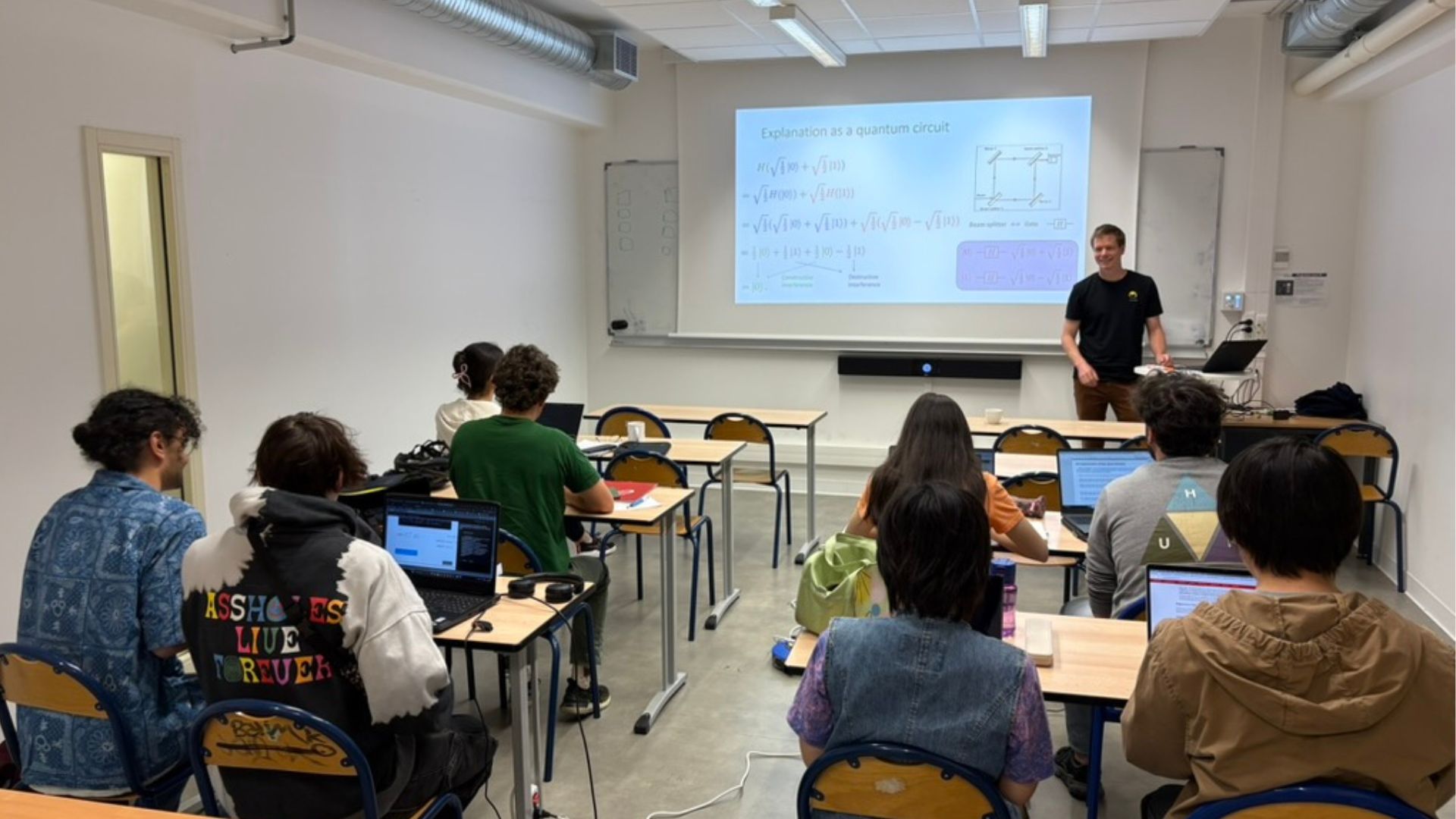
Attendees included interns from the Graduate School’s two masters programs, PhD students from the Institut de Recherche en Informatique Fondamentale (IRIF) and the Matériaux et Phénomènes Quantiques (MPQ) laboratory, and IRIF post-docs.
During the day, they had the opportunity to learn how to code well-known quantum algorithms using a quantum software development environment.
No prior knowledge of a quantum programming language was required, only a basic knowledge of the Python programming language was recommended for accuracy analysis.
Understanding a key concept: “phase estimation”
The morning session was dedicated to a fundamental algorithm in quantum computing: “phase estimation”.
Quantum computing specialist Vivien Londe showed students how this algorithm works, making it one of the most important quantum algorithms for chemistry.
Let’s pratice: “Hamiltonian simulation”
The afternoon session introduced students to Hamiltonian simulation. How does it work? Use a quantum system that we control well (the quantum computer) to simulate another quantum system that we want to investigate.
An instructive session appreciated by students
“It was an excellent opportunity to get an overview of some key concepts in quantum programming and to start working with quantum programming languages. Fundamentals as well as more specialized topics were clearly explained.” Student attendee
“The session is very well designed. I appreciated the simplifications made to the content, for example the implementation of a simple example of phase estimation instead of the more general version, which is very instructive and makes the session more accessible. I also really liked the illustration of phase estimation with the analogy of water waves and light beams.” Student attendee
À lire aussi
Eiffel Excellence scholarship 2027
The Eiffel scholarship programme launched by France’s Ministry of Europe and Foreign Affairs is now open for the 2027–2028 academic year. The programme enables international students to benefit from a mobility grant and pursue courses at the master’s and doctorate...
read more
Bourse d’excellence Eiffel 2027
L'appel à candidature bourse Eiffel pour l'année académique 2027-2028 est ouvert. Instauré par le Ministère de l’Europe et des Affaires Étrangères, le programme de bourses Eiffel permet aux meilleurs étudiants et étudiantes internationaux de bénéficier d’une aide à la...
read more
SANTÉ MENTALE : COMPRENDRE LES VULNÉRABILITÉS, ACCOMPAGNER LES PARCOURS
SANTÉ MENTALE :COMPRENDRE LES VULNÉRABILITÉS, ACCOMPAGNER LES PARCOURSÀ l’occasion de la Journée mondiale de la santé mentale, le 10 octobre, l’Université Paris Cité met en lumière quelques-unes de ses recherches, formations et initiatives interdisciplinaires...
read more
La photographie, autrement : deux nouveaux ouvrages chez Université Paris Cité Éditions
Le 16 octobre, Université Paris Cité Éditions publie deux nouveaux ouvrages dans sa collection « Longue vue », consacrée à la photographie et au patrimoine visuel. Avec Michel Butor. Portrait ultrasensible et Traverser le monde. Le tournant photographique de...
read more