

Ryugu: Asteroid Samples Continue to Shed Light on Solar System History
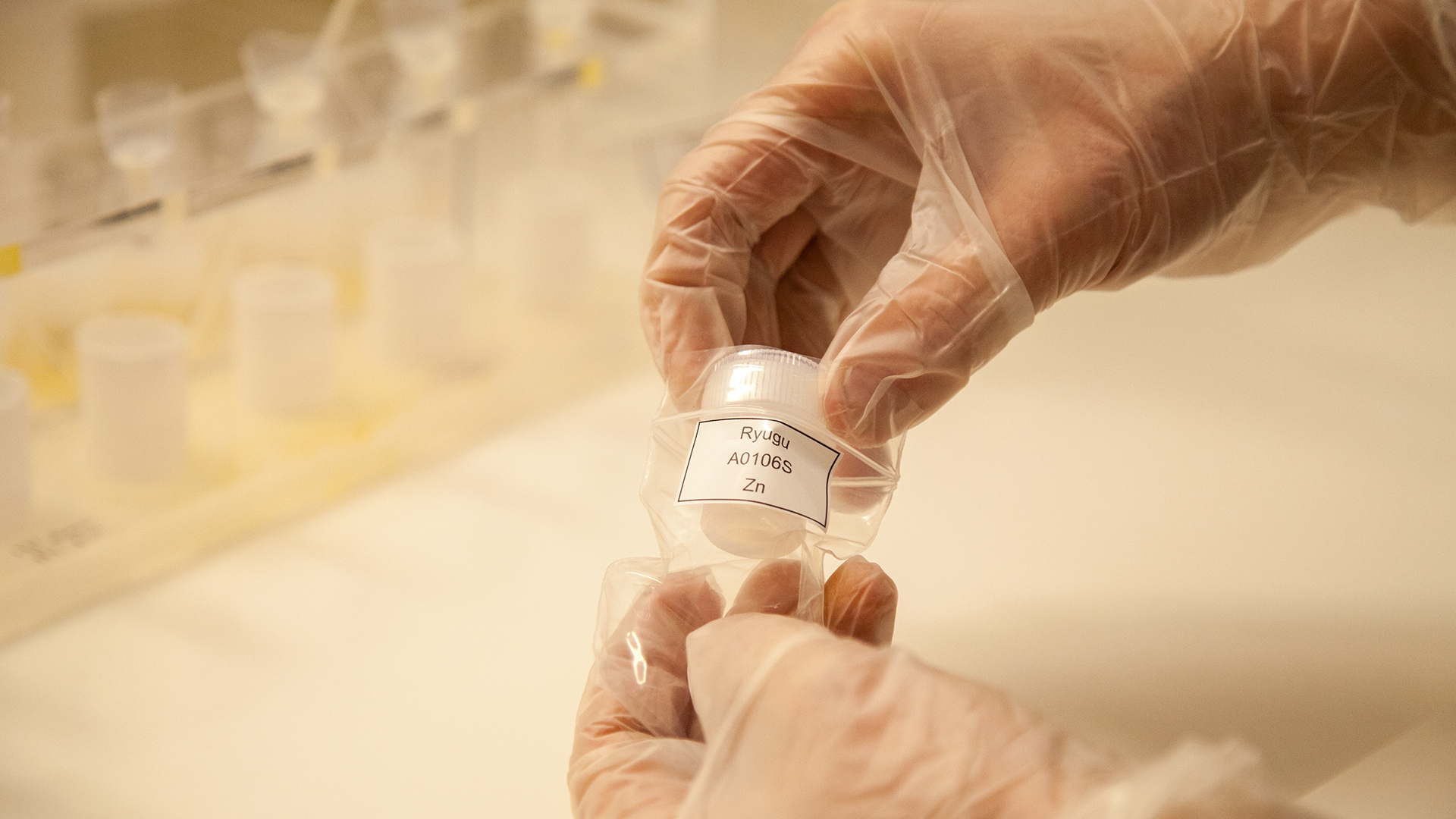
© IPGP
Samples of asteroid Ryugu analysed at IPGP
Nearly two years after Japanese mission Hayabusa2 returned to Earth, samples from asteroid Ryugu continue to reveal valuable information about the history of the early solar system. A study by scientists from the Institut de Physique du Globe de Paris, Université Paris Cité and CNRS, as part of an international consortium, reveals the isotopic composition of zinc and copper of asteroid Ryugu. The isotopic signatures show that Ryugu’s composition is close to Ivuna-like carbonaceous chondrites, and that Ryugu-like material from the outer solar system accounts for ~5-6% of Earth’s mass. These results are published on 12 December 2022 in the journal Nature Astronomy.
Meteorites found on Earth give scientists access to samples representing the first moments of the solar system. However, the return to Earth in December 2020 of the Hayabusa2 mission, operated by the Japanese space agency JAXA and bringing back 5 grams of fragments from the asteroid Ryugu, marks a major step forward by offering the possibility of analyzing samples unaltered by their arrival and stay on Earth. The first analyses, carried out by an international team, including researchers from the Institut de physique du globe de Paris, Université Paris Cité and the CNRS, have shown that the composition of the asteroid Ryugu is close to that of Ivuna-like carbonaceous chondrites (CI) – the most chemically primitive meteorites, and considered to have the composition closest to the Sun. However, some isotopic signatures (e.g., titanium and chromium) overlap with other groups of carbonaceous chondrites, so the details of the link between Ryugu and CI chondrites are not yet fully understood.
Zinc and copper are two moderately volatile elements, and are key elements to study the processes of accretion of volatiles during the formation of telluric planets. The different groups of carbonaceous chondrites show distinct zinc and copper isotopic compositions, with the CI chondrites being the more enriched in volatile elements. By carrying out additional analyzes of the zinc and copper isotopic composition of Ryugu, the scientists had access to a crucial tool for studying the origin of the asteroid.
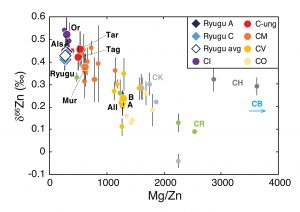
Zinc elemental and isotopic compositions for Ryugu and carbonaceous chondrites samples. (Source: Contribution of Ryugu-like material to Earth’s volatile inventory by Cu and Zn isotopic analysis, Marine Paquet, Frederic Moynier, Tetsuya Yokoyama et al., Nature Astronomy, 2022)
The international team showed, in a study published on December 12th, 2022 in the journal Nature Astronomy and led by Marine Paquet and Frédéric Moynier, cosmochemists at the IPGP, that the isotopic ratios of copper and zinc in the samples from Ryugu were identical to CI chondrites but different from all other types of meteorites. By finally confirming the similarity between Ryugu and CI chondrites, this study establishes that these primitive samples from Ryugu represent the best estimate of the solar composition to date for copper and zinc.
Finally, the zinc isotopic composition of Ryugu can also be used to study the accretional history of moderately volatile elements on Earth, which are essential for the development of planetary habitability. The study also demonstrates that the contribution of Ryugu-like material represents about 5% of the Earth’s mass.
> Bibliography:
Contribution of Ryugu-like material to Earth’s volatile inventory by Cu and Zn isotopic analysis, Marine Paquet, Frederic Moynier, Tetsuya Yokoyama et al., Nature Astronomy, 2022, DOI : 10.1038/s41550-022-01846-1
Read more
FENS 2026: Graduate School Neuroscience students at the heart of international research
This summer, 25 Master's students from Université Paris Cité's Neuroscience Graduate School attended the FENS (Federation of European Neuroscience Societies) Forum 2026 in Barcelona, Europe's leading neuroscience conference. This was a unique opportunity to immerse...
read more
FENS 2026 : les étudiantes et étudiants de la Graduate School Neuroscience au plus près de la recherche internationale
Cet été, 25 étudiantes et étudiants en master de la Graduate School Neuroscience de l’Université Paris Cité ont participé au FENS (Federation of European Neuroscience Societies) Forum 2026 à Barcelone, le grand rendez-vous européen des neurosciences. Une occasion...
read more
La photographie, autrement : deux nouveaux ouvrages chez Université Paris Cité Éditions
Le 16 octobre, Université Paris Cité Éditions publie deux nouveaux ouvrages dans sa collection « Longue vue », consacrée à la photographie et au patrimoine visuel. Avec Michel Butor. Portrait ultrasensible et Traverser le monde. Le tournant photographique de...
read more
Eiffel Excellence scholarship 2027
The Eiffel scholarship programme launched by France’s Ministry of Europe and Foreign Affairs is now open for the 2027–2028 academic year. The programme enables international students to benefit from a mobility grant and pursue courses at the master’s and doctorate...
read more