


The tiger mosquito Aedes albopictus, native to Southeast Asia, is one of two vectors for transmission of the chikungunya virus to humans. Scientists at Université Paris Cité and the Institut Pasteur have shown that this mosquito can acquire the ability to transmit the chikungunya virus as effectively at 20°C as at 28°C. The spread of the tiger mosquito in temperate climates could therefore result in the spread of the chikungunya virus in those regions.
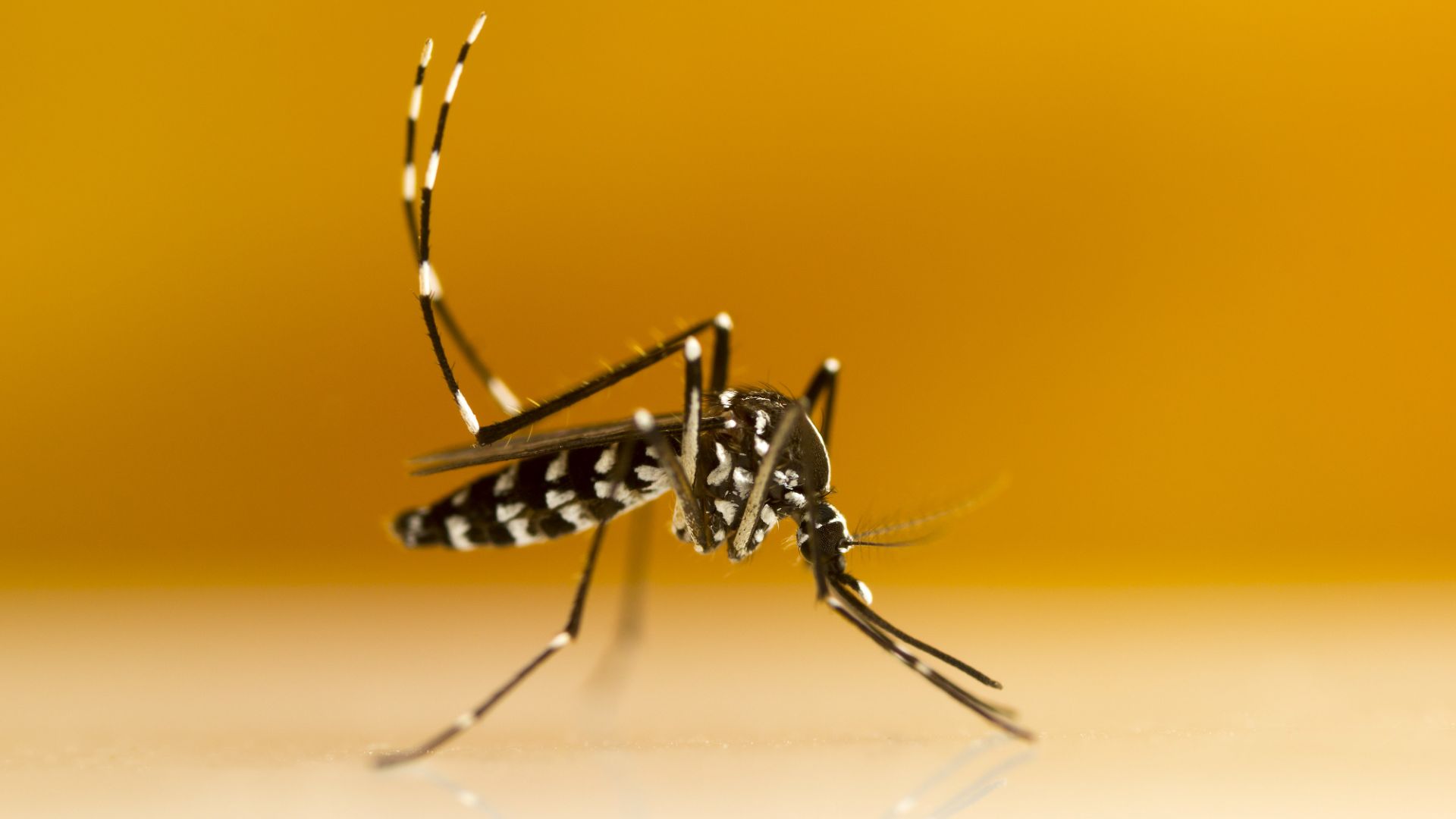
Aedes albopictus mosquito
© gordzam – stock.adobe.com
The recent emergence of vector-borne diseases has marked a turning point in public health, as they are now affecting regions that are increasingly distant from endemic areas. This is due to changes in the environment and the increase in trade and travel between continents. The chikungunya virus was first reported in Europe in 2007 during an epidemic in Italy. The first indigenous cases of chikungunya in the south of France were observed in the autumn, first in 2010 and again in 2014 and 2017[1]. The question inevitably arises of the effects of climate, and in particular temperature, on the transmission of pathogens by mosquitoes.
In this study, scientists from the Institut Pasteur and Université Paris Cité looked at the transmission of the chikungunya virus by the tiger mosquito Aedes albopictus at an ambient temperature of 20°C or 28°C. The minimum temperature recorded during recent epidemics in continental Europe was 20°C. 28°C is the average temperature in tropical countries where the virus usually circulates.
Using tiger mosquitoes sampled in their natural habitat in Montpellier, the researchers analyzed the adaptive molecular mechanisms induced by temperature.
“We demonstrate that temperature profoundly alters gene expression and the bacterial microbiome of mosquitoes,” explains Anna-Bella Failloux, Head of the Institut Pasteur’s Arboviruses and Insect Vectors Unit and last author of the study. The scientists observed different gene expression profiles at 20°C and 28°C in mosquitoes infected with the virus. Moreover, the microbiome of mosquitoes infected with the chikungunya virus is modified at 28°C, with a significant decrease in Wolbachia bacteria correlated with an increase in Serratia bacteria contributing to viral transmission. The Wolbachia bacterium inhibits viral replication and the Serratia bacterium promotes infection of the mosquito’s midgut by the virus.
Temperature also affects the viral genome in infected mosquitoes. “The genetic diversity of the chikungunya virus was also modified. All these changes induce molecular changes that result in effective transmission of the pathogen,” says Anna-Bella Failloux. “In this study, the Aedes albopictus mosquito was able to transmit chikungunya as effectively at 20°C as at 28°C, but via very different molecular processes. This is a true example of mutual adjustment between virus and vector, in this case the tiger mosquito, in response to environmental conditions,” adds the scientist.
The tiger mosquito is now present in temperate regions such as the American continent, temperate Asia and nearly 28 European countries, including France since 2004. In a few decades, it has spread across four fifths of France. “Chikungunya is therefore likely to continue to spread in areas where the tiger mosquito is established. In the absence of vaccines and treatments, it could become a public health problem in a greater number of countries with temperate climates,” concludes Anna-Bella-Failloux.
[1]At present, all autochthonous cases reported in mainland France derive from imported cases and are not derived from an enzootic transmission cycle. In 2010, the imported cases were in two individuals who had recently returned from Rajasthan and instigated a chain of transmission that led to the first indigenous cases recorded in mainland France.
Read more
Finale Ma Thèse en 180s : le 31 mars 2026, votez pour le prix du public
Humour, poésie, jolies histoires... 15 candidates et candidats représentant l’Alliance Sorbonne Paris Cité (ASPC) au concours Ma Thèse en 180 secondes s’affronteront en finale locale devant les jurys et le public, le 31 mars 2026 à 18h30. La finale sera retransmise en...
One in ten European bee species at risk, new biodiversity warning
The new european red list of bees published on February 26th catalogs almost 2000 species and draws a worrying observation that 172 species in Europe are now endangered. 10 years after a first partial assessment, our understanding of the situation has become much...

Journée Mondiale de la Santé 2026

Research Call for Proposals 2026 Université Paris Cité – University of Toronto
As part of the strategic partnership between Université Paris Cité (UPCité) and the University of Toronto (U of T), a new research call for proposals is launched for 2026. The submission deadline is May 13, 2026. Two previous calls were held in 2024 and 2025, with a...