

Following the successful impact of NASA’s DART mission on the asteroid Dimorphos, the European Space Agency’s (ESA) HERA mission, in which Sébastien Charnoz, professor at Université Paris Cité and astrophysicist at the IPGP, is participating, will leave in 2024 to determine the precise effect of this impact on the asteroid pair and their orbits.
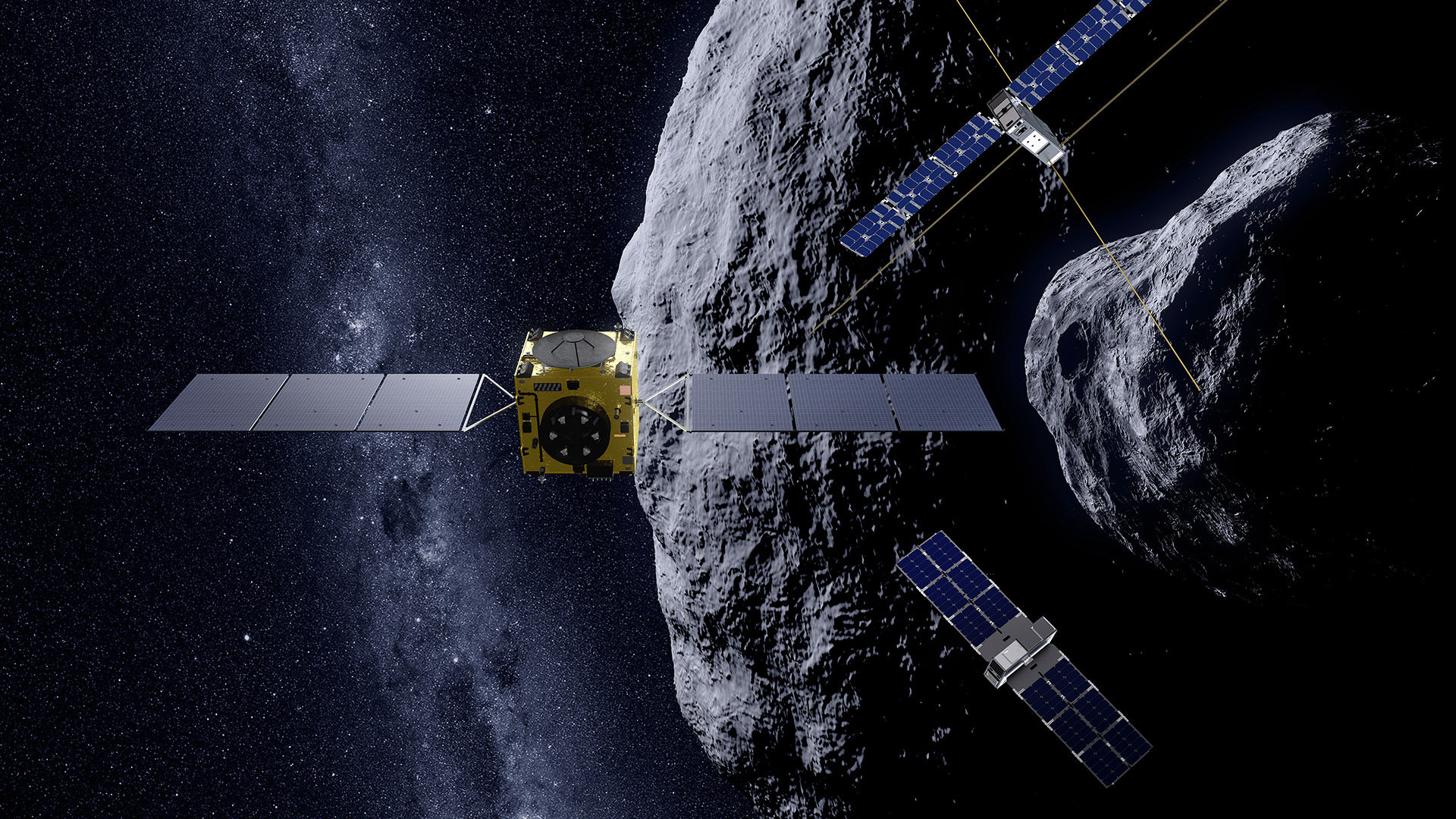
© ESA/Science Office
On 26 September at 1.14 am in France, the American satellite DART (Double Asteroid Redirection Test) crashed, as planned, into the moon (Dimorphos, 160m in diameter) of the small asteroid Didymos (800m in diameter). This double asteroid is currently about 12 million km from Earth and poses no threat to our planet! But this deflection experiment is being conducted by NASA, in conjunction with ESA, to better understand how an asteroid responds to an inertial impactor (a heavy but non-explosive charge).
NASA’s DART satellite hit Dimorphos at the dizzying speed of 22 000 km/h (for a weight of 500 kg) with the aim of deflecting it slightly. The scene was filmed live from a camera (DRACO) on board the impactor, but the impact was also observed from observatories on Earth and by the James Webb Space Telescope. In the final minutes of the approach, the images revealed the chaotic geography of the Didymos-Dimorphos pair: deep craters, dusty valleys, and rocky plains. These asteroids had never been photographed before at high resolution, and it was in the last minute of the approach that their shapes were revealed.
As suggested by early analysis using radar shots ahead of the mission, the main body, Didymos, is shaped like a diamond, while Dimorphos, the smaller moon and target of the DART mission, is elongated like a rugby ball due to tidal effects.
But if the impact is a success, it is now a question of determining its precise effect on the asteroid and its orbit. This is the role of the European Space Agency’s (ESA) HERA mission, a follow-up to NASA’s DART mission, in which Sébastien Charnoz, professor at Université Paris Cité and astrophysicist at IPGP, is participating.
The European mission, which involves ten European countries, will take off in October 2024 to orbit the Didymos/Dimorphos pair in 2026, and measure, 4 years after the impact, the precise orbital evolution of Dimorphos in order to understand the amount of energy and impulse that will have been communicated on 26 September by the DART impactor. These observations and measurements will help determine the extent to which we are able to deflect an asteroid should it pose a threat in the future.
In the HERA science team, Sébastien Charnoz is a member of the ‘Dynamics’ group, in charge of analysing the data and predicting the long-term response of Dimorphos using numerical models. Among the secondary objectives of the mission, the IPGP also wishes to measure the dissipation of the impact energy in the asteroid, the tidal effects, as well as the internal structure of the Didymos-Dimorphos pair. The IPGP team of astrophysicists will also continue to study the origin and evolution of this small satellite. Their first scenario, recently published, seems to be in full agreement with the first images of the DART mission!
More information:
> The NASA Dart mission website
– The ESA Hera mission website
À lire aussi

Great Success for the 2026 Edition of the JAVA Back-to-School Festival
A must-attend event at the start of the academic year, the Welcome and Student Association Days, or Journées d’Accueil et de la Vie Associative (JAVA), kicked off September at Université Paris Cité. The highlight of this 2026 edition: the Back-to-School Festival...
read moreProtected: [UE Engagement ] Créathon étudiant : trois jours pour imaginer des futurs possibles
Password Protected
To view this protected post, enter the password below:

Vous aidez un proche ? Nous vous aidons !
Dans le cadre de la Journée Nationale des Aidants le 6 octobre prochain, l’Université Paris Cité organise une action de sensibilisation à la question de l’aidance. Étudiantes et étudiants aidants, faites-vous (re)connaître ! Lire la suite Vous aidez un proche ? Nous vous aidons !
read more
Appel Émergence Recherche « Début de carrière » 2026 : 53 projets financés !
L’appel à projets Émergence Recherche « Début de carrière » soutient le démarrage d’une nouvelle thématique de recherche et/ou la réalisation d’une étude pilote. Il vise à renforcer la dynamique de recherche facultaire et interfacultaire de l’Université Paris Cité....
read more