

Last June, the seventh flagship initiative of the Strategic Partnership InnovEd4TS was hosted virtually at Humboldt Universität zu Berlin (HU-Berlin). Invited experts from four Circle U. universities and the University of Lisbon met around the flagship initiative HU-Q Programme, a university-wide initiative for research-based learning. Since the programme started in 2012, Humboldt Universität’s laboratory for innovation in teaching and learning, the bologna.lab, has facilitated 419 Q-Projects for 3,560 student participants from all disciplines.
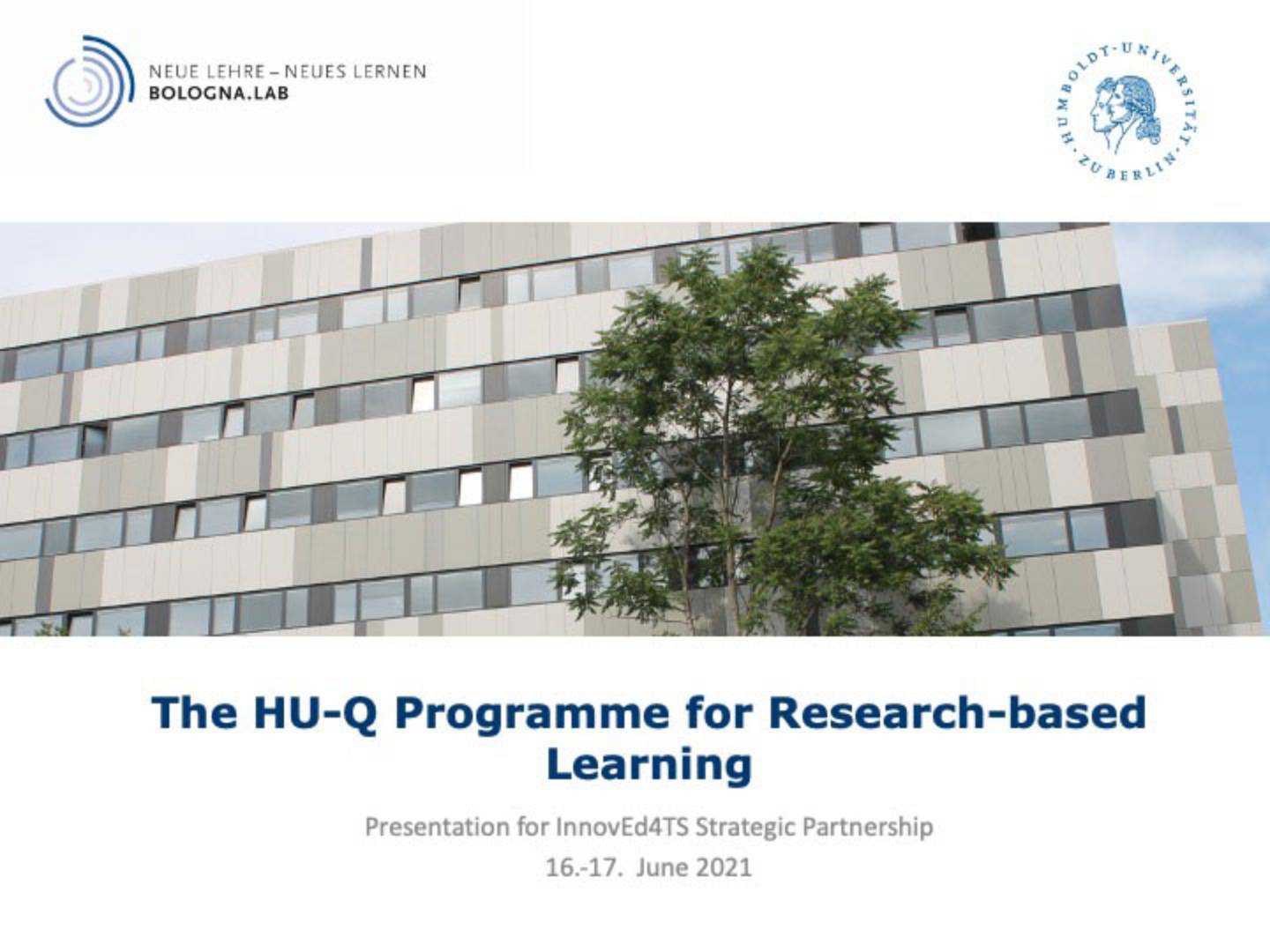
Strategic Partnership InnovEd4TS (Innovative Education for Transferable Skills), is five member universities of Circle U. Alliance: Humboldt University, UCLouvain, University of Oslo, University of Aarhus and Université Paris Cité along with the University of Lisbon
Photo credit Humboldt-Universität zu Berlin
The HU-Q Programme led by the bologna.lab aims at:
- strengthening the research-teaching nexus at HU-Berlin, in particular at the undergraduate level.
- fostering the “shift from teaching to learning” by introducing learning formats that are focused on the construction of knowledge, the active acquisition and development of competencies, rather than traditional “knowledge transmission”.
- enhancing the quality of teaching by providing training in research-based education to students, researchers and teaching staff leading the student research projects.
HU-Q Programme is a competitive research opportunities programme which proposes 3 formats targeted at students, junior researchers and researchers.
What is Research-Based Learning or RBL?
During the visit, the Leads of the HU-Q programme, Wolfgang Deicke and Laura Schilow, provided the experts with solid references and definitions for Research-Based Learning or RBL.
“Most, if not all subjects taught at the university have a connection to research and part of university education is to prepare students for research in their discipline”, starts Wolfgang Deicke.
“But most of university research training is based on knowledge transmission or the guided development of applied skills”. “Independent research” starts when students are presented with a research problem to solve individually (or in groups) or given the opportunity to develop a research project by themselves. “It is these types of activities that we would class a research-based learning. It is distinct from the other types of research-related teaching in that it requires the students to be more active and engaged in knowledge production. They may not always produce “original” research, but they gain insights and skills that are new to them personally”, explains Laura Schilow.
Visit the Circle U. website to learn more about the programme and read the article in full.
Read more
Eiffel Excellence scholarship 2027
The Eiffel scholarship programme launched by France’s Ministry of Europe and Foreign Affairs is now open for the 2027–2028 academic year. The programme enables international students to benefit from a mobility grant and pursue courses at the master’s and doctorate...
Do you have to be bilingual to participate in Circle U. activities
Going abroad to study in a foreign language can seem intimidating. Yet a first experience may be all it takes to build confidence and take the leap. Irina tells us how taking part in one of Circle U.’s summer schools helped her gain confidence and prepare for a...
How Circle U. helped me define my career path
Susanna’s journey with Circle U. began with an online course. This first experience allowed her to discover the alliance and marked the beginning of a journey that led her to become a student ambassador, pursue a double degree in Paris, and complete an internship at...

A journey to self discovery – the story of a Circle U. Student Fellow
What if one conference could change the direction of your studies and make you rethink what you want to do with your future? This is the story of Emma, who discovered a new path through an unexpected Circle U. opportunity. Her experience is a reminder of the value of...